What is the UNIVERSE?
The universe is everything that exists — every star, planet, moon, galaxy, and even the empty space between them. It's so enormous that scientists still don't know where, or if, it ends
A tiny patch of deep space, packed with distant galaxies
Inside the universe are billions of galaxies, and each galaxy holds billions of stars. Our own galaxy — the one we live in — is called the Milky Way.
the Milky Way Galaxy
The Milky Way is a giant spiral of stars, shaped a bit like a pinwheel slowly turning in space. Earth, our Sun, and our whole solar system sit on one of its outer arms.
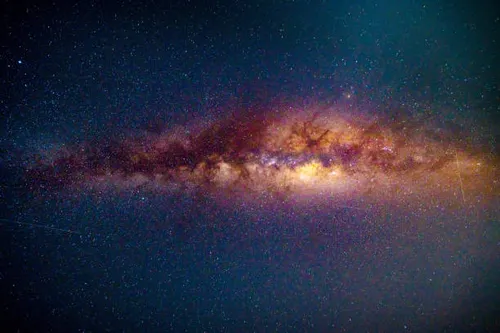
The Milky Way stretching across a dark night sky
Why does it look like a spiral?
Gravity pulls stars, gas, and dust into rotating arms, similar to water swirling down a drain — except this "drain" is a supermassive black hole at the very center.
How long is a trip around the galaxy?
It takes our Sun about 230 million years to travel once around the center of the Milky Way. Dinosaurs were still around the last time we were in this spot!
Whats hiding at the center?
A supermassive black hole sits at the heart of the Milky Way. It's so heavy that nothing — not even light — can escape once it gets too close.
Fast Facts about space
Light from the sun takes 8 minutes to reach us
Even though light travels incredibly fast, the Sun is so far away that its light needs about 8 minutes to arrive at Earth.
Space is completely silent
Sound needs air (or another material) to travel through. Since space is mostly empty, there's nothing for sound waves to move through — so it's totally silent out there.
A day on Venus is longer than its year
Venus spins so slowly on its axis that one full spin (its "day") takes longer than one full trip around the Sun (its "year").
Galaxies come in different shapes
Some galaxies spiral like the Milky Way, some are oval-shaped, and some have no clear shape at all — astronomers call these "irregular" galaxies.
A Quick Tour of the Planets
Scroll sodeways to visit few of our closest neighbors in the solar system.
Saturn
Famous for its wide rings made of ice and rock chunks.
Mars
Know as the Red Planet because of rusty iron (Fe) in its soil.
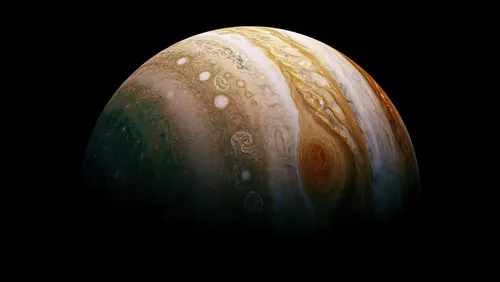
Jupiter
The largest planet - a giant ball of swirling gas.
Earth
Our Home - the only planet we know with life.